

In order to get a better understanding of the implications of monitoring a complex heterogenous data fabric coupled with a diverse set of tools for control and orchestration, it would be useful to view the data fabric, and various points across that fabric that need to be monitored as “the monitoring plane”.
The ability to monitor signals at various points across points a heterogenous fabric, as it flows through pre, and post processing functions to obtaining a good understanding of signal quality, metadata and formats is critical. Locating problems that might compromise a high pressure live production is of paramount importance.
The Monitoring Plane perspective helps us realize a well-defined and structured approach that is valuable in designing a system that caters to the needs of operators, managers and executives in the broadcast industry enabling them to meet KPA’s and related predetermined standards for QOS and QOE.
 Continuing with the notion of abstracting The Monitoring Plane™, on the lines of “Control” and “Data” planes, we could list a set of attributes that would be required of an effective monitoring plane. One way to break the problem down while trying to understand these attributes, is to separate monitoring into the two broad areas of “signals to monitor”, and “unified operator interfaces for monitoring”.
Generally speaking, the following are attributes that would help define The Monitoring Plane:
- Signal Agnostic: Visual representation of monitored signals should ideally be consistent, independent of signal type, weather baseband or IP, compressed or uncompressed.
- Location Agnostic: The data fabric over which broadcast signals flow, can now span local facilities, remote trucks (OBV’s), Cloud infrastructure and also on-premise equipment. Ideally The Monitoring Plane should be able to provide a consistent monitoring experience, independent of where the signal originates or terminates.
- Consistent Media Analysis: A consistent way to view video and listen to audio signals being monitored across a heterogenous fabric provides a predictable operator experience, focusing their attention on the task of monitoring, rather than having to worry about specific monitoring tools and mapping signals across those tools to obtain a consistent view.
- Audio Loudness: The ability to monitor parameters like audio loudness across signal types, can again help improve consistency of the monitoring experience. Visual representation of audio loudness can help quickly diagnose audio level problems in particular when there is a transfer of signals across varying underlying data fabrics, and potentially across broadcasters and service providers, as they link signals with each other.
- Signal Metadata: A clear context specific visual representation of signal metadata, again independent of signal types is an important attribute to consider. This might mean CC information in the VANC section of an SDI signal, or IP packet losses and delays for a ST2110 signal. The monitoring plane should ideally present signal metadata as it relates to the signal being monitored, separate from a unified representation of the “media” portion of the signal like video, audio and loudness.
- Automated Alerting: To help scale up operator productivity, on important attribute of The Monitoring Plane would be to help move in the direction of “monitoring-by-exception”, meaning that the operator’s attention should ideally be drawn towards monitoring only when there is an exception that demands that attention. As a result, the ability to alert the operator in the event of a deviation, weather in signal metadata or the media portion of the signal is extremely important.
- Vendor Agnostic: Yet another important attribute of The Monitoring Plane is the need to be able to use “open industry standard” tools to monitor signals, without having to resort to vendor specific applications, that prevent a broad interconnected consistent monitoring experience for operators.
- Open Standards: The Monitoring Plane is a big idea, and not something that any single industry vendor can hope to solve single handedly. It is therefore important, that realizations of the Monitoring Plane use open industry standards, that can enable various industry players to integrate and connect across other vendors’ applications, with a shared goal of solving customer problems.
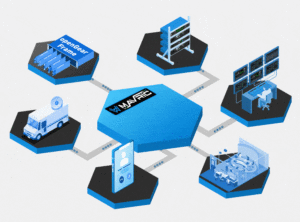 Having done all the groundwork on researching the problem space and proposing a generalized set of principles to solve our customers’ problems with regards to broadcast signal monitoring, Wohler have built a product that we see as a starting point in this journey towards realizing a comprehensive Monitoring Plane.
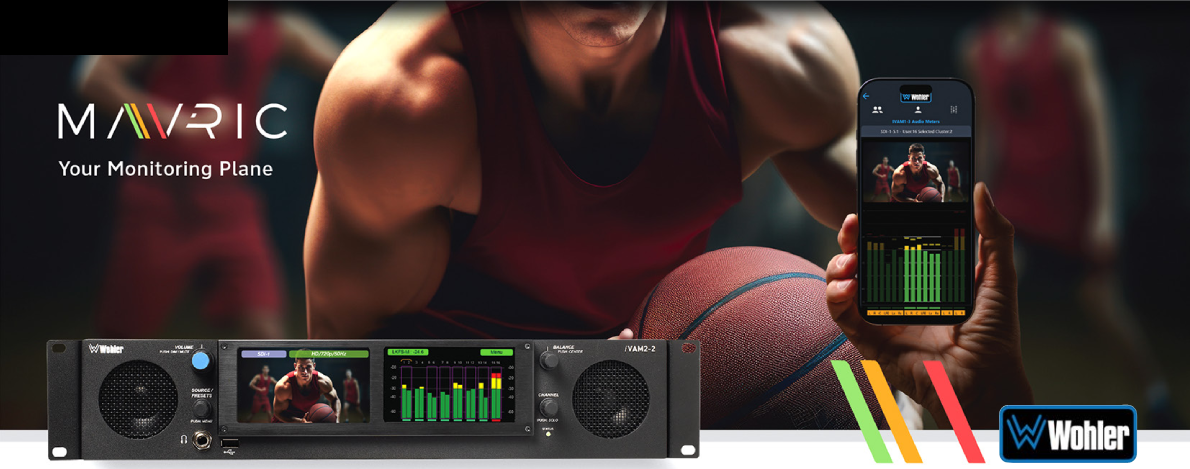
Wohler recently launched “MAVRIC”, which is an abbreviation for “Multichannel, Audio and Video Remote Indication and Control”. MAVRIC was recently awarded the Best of Show at IBC2024, as a recognition of the fact that it breaks new ground in the area of broadcast signal monitoring.
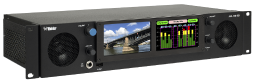
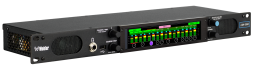
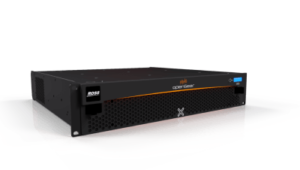
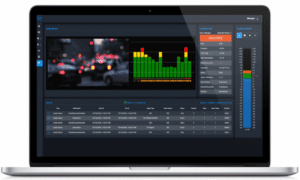
MAVRIC provides for three core function, Remote Monitoring, Automated Alerting and Integrated Conferencing. MAVRIC uses a simple architecture, where our in-rack gear supplemented by openGear monitor-on-a-card hardware are used to realize “probes”. These “probes” connect into our Cloudbased application that is accessed using a standard web browser. The Cloud based application enables monitoring of signals connected to probes that could be located anywhere in the world, and presents a consistent view of signals, entirely independent of the signal type – baseband or IP.
Further, probes stream encoded audio and video into the Cloud, enabling operators to see live video and listen to audio from the probes. Media streaming infrastructure for MAVRIC can be deployed on-premise, should the customer require media signals to remain in-network.
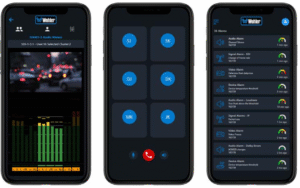
The software application is complemented by an Android/iOS mobile app, freely downloadable from the App/Play store. The system can be set up to fire alerts for preconfigured conditions, that are then paged to the mobile app, helping customers realize a true “monitoring-by-exception” paradigm. The mobile app also includes a built in “conferencing” function that allows operator groups to quickly connect “in-context” to drive resolution to problems as they occur. The system is designed to be secure, configurable and horizontally scalable to rapidly expand per customer requirements. Wohler continues to innovate in the area of launching new “probe types”, with an SRT probe on the horizon for launch at IBC2025.
We are also working with partners specializing in building control surface products, by enabling them to complete a rapid, lightweight integration of MAVRIC probes into their control surface. That enables customers to have monitoring integrated into their control surface for rapid cross checking of signal orchestration. We will be demonstrating this integration at NAB 2025 in Las Vegas
Please visit Wohler Technologies at booth #N939 at NAB 2025 for more information.