

Remote Production At Scale
The broadcast industry has moved beyond debating whether remote roduction works. The question now is how to make distributed workflows scalable, resilient, and operationally sustainable – particularly for live sports and news, where failure is public and recovery time is measured in seconds. As REMI (Remote Integration) production models mature and cloud adoption accelerates, broadcasters are discovering that signal transport is only one piece of the puzzle.
The deeper challenge is maintaining technical visibility, operational awareness, and real-time collaboration across increasingly fragmented production ecosystems.
The Evolution of REMI and Distributed Production
Remote integration (REMI) models were initially adopted to reduce travel costs and minimize on-site crew requirements for live sports. Early implementations focused on transporting camera and audio feeds from venues back to centralized production hubs.
Today, those models have expanded significantly:
- Multiple simultaneous live events managed from centralized control rooms
- Production staff working from home or regional facilities
- Hybrid workflows combining baseband, IP, and cloud-native systems
- Contribution feeds sourced from third-party providers and OTT platforms
Live news organizations have undergone a similar transformation. Regional bureaus, freelance crews, bonded cellular links, and cloud-based editing systems are now integral to daily operations.
As workflows become more distributed, the traditional monitoring paradigm – racks of in-room displays watched by operators in a single facility – no longer scales effectively.
The "Control Plane"
This complex fabric of “data” (signal) transport across broadcast facilities has at its core switchers, peripherals, encoders and decoders that process signals pre or post switching. This core is now also evolving with IP technologies, enabling the use of tools that achieve routing and control in software that could be hosted locally or in the Cloud.
An additional dimension is the gradual integration of application specific processing programs that run entirely in software and could also be hosted in the Cloud. This requires signals to be uplinked into the Cloud for processing, and potentially downlinked back to on-premise locations prior to distribution. Orchestration, switching and processing functions across these workflows, with data flows across the Data Plane could be broadly viewed as the “Control Plane”.
Continuing with this perspective suggests the need to define a “Monitoring Plane”.
Monitoring as Infrastructure, Not Accessory
In legacy environments, monitoring was often treated as a localized technical function. In distributed production, it becomes a strategic capability.
Broadcasters now require monitoring systems that:
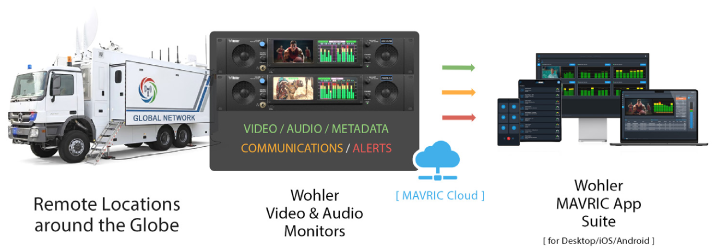
- Provide secure, remote access to live audio and video signals
- Deliver real-time insight into signal health and compliance
- Scale across multiple concurrent productions
- Integrate seamlessly into hybrid IP and cloud workflows.
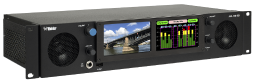
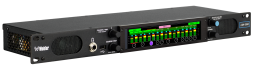
Systems like Wohler’s MAVRIC extend the concept of signal confidence beyond the control room, enabling authorized users to view and listen to feeds from anywhere using secure browser-based or mobile interfaces.
This shift redefines monitoring from a room-based activity to a role-based service, aligned with how modern production teams operate.
Live Sports: Complexity at Scale
Sports production is arguably the most demanding use case for distributed workflows. A single Tier 1 event may involve:
- Dozens of camera feeds
- Multiple commentary positions and languages
- Crowd and effects microphones
- Graphics, replay, and program outputs
- Simultaneous distribution to broadcast and streaming platforms
In centralized REMI models, only acquisition remains on site. Production control, replay, audio mixing, and engineering oversight are often located elsewhere – sometimes across international borders. Maintaining visibility into every signal becomes both technically and operationally critical.
Practical Scenario: Multi-Venue Remote Sports Production
Consider a broadcaster covering a national league weekend, with matches occurring simultaneously in five cities. Rather than deploying full production teams to each venue, camera and audio acquisition teams operate locally while production staff are centralized.
Using distributed monitoring infrastructure:
- Central engineers view and listen to feeds from all five venues simultaneously.
- Audio supervisors verify commentary feeds, language channels, and surround mixes remotely.
- Producers monitor program outputs before distribution to affiliates and OTT platforms.
If a venue experiences intermittent audio dropouts, automated alerts immediately flag the issue. Engineers can isolate the affected channel, initiate communication with on-site technicians, and resolve the problem before it escalates into a visible on-air disruption.
The economic advantages of REMI are well documented. Monitoring and alerting systems are what make these models operationally viable at scale.
Audio: The Hidden Risk in Remote Production
In live sports and news, video issues are often quickly detected by viewers. Audio issues, however,
can be subtler yet equally damaging.
Commentary loss, incorrect channel mapping, phase issues, or loudness violations may not be immediately obvious in a distributed environment
unless robust multichannel monitoring is in place.
Remote monitoring platforms that support discrete channel inspection and loudness measurement allow audio engineers to:
- Verify channel routing integrity
- Confirm compliance with regional loudness regulations
- Detect silence or intermittent dropouts
- Monitor alternate language feeds
As more productions move toward immersive audio formats and personalized audio streams, the importance of scalable multichannel monitoring only increases.
Live News: Speed, Unpredictability, and Global Reachc
If sports production is defined by complexity, live news is defined by unpredictability. Breaking stories can originate from any location. Feeds may be delivered via atellite, fiber, bonded cellular, or IP contribution paths. Production decisions must be made in minutes, sometimes seconds.
In this environment, centralized visibility is critical.
Practical Scenario: Global Breaking News Event
A major geopolitical event unfolds overnight. Regional bureaus begin transmitting live feeds to headquarters. Editorial staff are preparing for a special broadcast, while engineering teams operate with reduced overnight staffing.
With distributed monitoring systems:
- Incoming feeds are automatically visible to central operations staff.
- Alerts notify engineers if audio silence or signal instability occurs.
- Producers can preview feeds remotely before committing them to air.
When a primary feed begins to exhibit video freeze, the issue is detected instantly through automated alerting. Engineering initiates a contextual communication session with the regional bureau while simultaneously switching to a backup contribution path.
To viewers, coverage appears seamless. This level of resilience is no longer optional for global news organizations operating in a 24/7
environment.
Monitoring by Exception: Reducing Operator Fatigue
As the number of monitored signals increases, manual oversight becomes unsustainable. Distributed production may involve dozens – or hundreds – of concurrent feeds across sports and news operations.
Monitoring-by-exception models, enabled by configurable alerting systems, allow operators to focus on issues that require intervention rather than passively observing stable signals. Alerts can be triggered by:
- Audio silence or threshold violations
- Video freeze, black frames, or format changes
- Metadata or caption discrepancies
- Transport stream or IP errors
In large-scale REMI environments, this approach reduces cognitive load while improving response times.
The strategic implication is clear: automation augments human oversight, allowing technical teams to manage more productions without compromising reliability.
Embedding Collaboration into Technical Workflows
Distributed production introduces communication complexity. Engineering teams, producers, and field technicians may be separated by geography and time zone.
Traditional workflows rely on separate monitoring systems and communication platforms, creating fragmentation during live incidents.
Integrated conferencing within monitoring platforms addresses this gap by allowing stakeholders to:
- Initiate secure audio or video calls within the monitoring interface
- Collaborate while viewing the same signals and diagnostic data
- Escalate issues to predefined groups instantly
This contextual collaboration shortens troubleshooting cycles and reduces misinterpretation.
Practical Scenario: Coordinated REMI Troubleshooting
During a high-profile sports final, an alert flags intermittent packet loss on a venue feed delivered over IP.
Central engineering views signal metrics and initiates a conference session with the venue’s technical lead. Both parties analyze the same feed and network diagnostics in real time.
Within minutes, the issue is traced to a misconfigured network switch and corrected – without requiring engineers to leave their monitoring environment or switch between disparate tools.
This level of integration reflects a broader industry shift toward unified operational platforms.
Hybrid Infrastructure: Bridging Baseband, IP, and Cloud
Industry discussions increasingly focus on IP transition and cloud-native workflows. Yet the reality for most broadcasters is hybrid infrastructure.
Legacy SDI systems coexist with ST 2110 environments. Cloud playout platforms integrate with on-premise master control. Contribution paths may traverse managed fiber networks, public internet, and satellite links.
Monitoring platforms must span this diversity.
Flexible deployment models – including onpremise, cloud-hosted, and hybrid architectures – allow broadcasters to maintain unified visibility while modernizing at their own pace.
As virtualized production environments expand, monitoring will need to integrate with orchestration layers and cloud management tools, becoming part of a broader observability ecosystem.
Strategic Implications for Broadcasters
The next phase of remote production will not be defined solely by cost reduction. It will be shaped by:
- Scalability across concurrent events
- Operational resilience under unpredictable conditions
- Integration across hybrid infrastructure
- Reduced dependence on physical control rooms.
Monitoring, alerting, and collaboration platforms are foundational to achieving these goals.
They enable:
- Centralized oversight of distributed workflows
- Rapid response to technical anomalies
- Reduced on-site staffing without sacrificing quality
- Greater flexibility in workforce deployment
In effect, they transform monitoring from a passive safeguard into an active enabler of distributed production strategy.
Looking Ahead: Monitoring in the Era of Virtualized Production
As the industry evolves towards software-defined remote production the need for distributed observability will only intensify.
The evolution of platforms such as MAVRIC drives monitoring to become increasingly intelligent, interconnected, and central to broadcast operations.
Conclusion
The shift toward distributed production in sports and live news is no longer experimental – it is structural. REMI workflows, hybrid cloud integration, and decentralized teams are now part of mainstream broadcast operations.
In this environment, maintaining visibility, responsiveness, and collaboration across locations is critical. Wohler’s MAVRIC combines remote signal access, automated alerting, and embedded communication to represent an essential layer of infrastructure in the modern broadcast stack.
As the industry evolves to next generation production technologies, one principle is becoming clear: successful remote production is not only about moving signals efficiently. It is about ensuring that wherever those signals travel, the right people can see them, hear them, analyze them, and act on them instantly.